
May 20, 2026
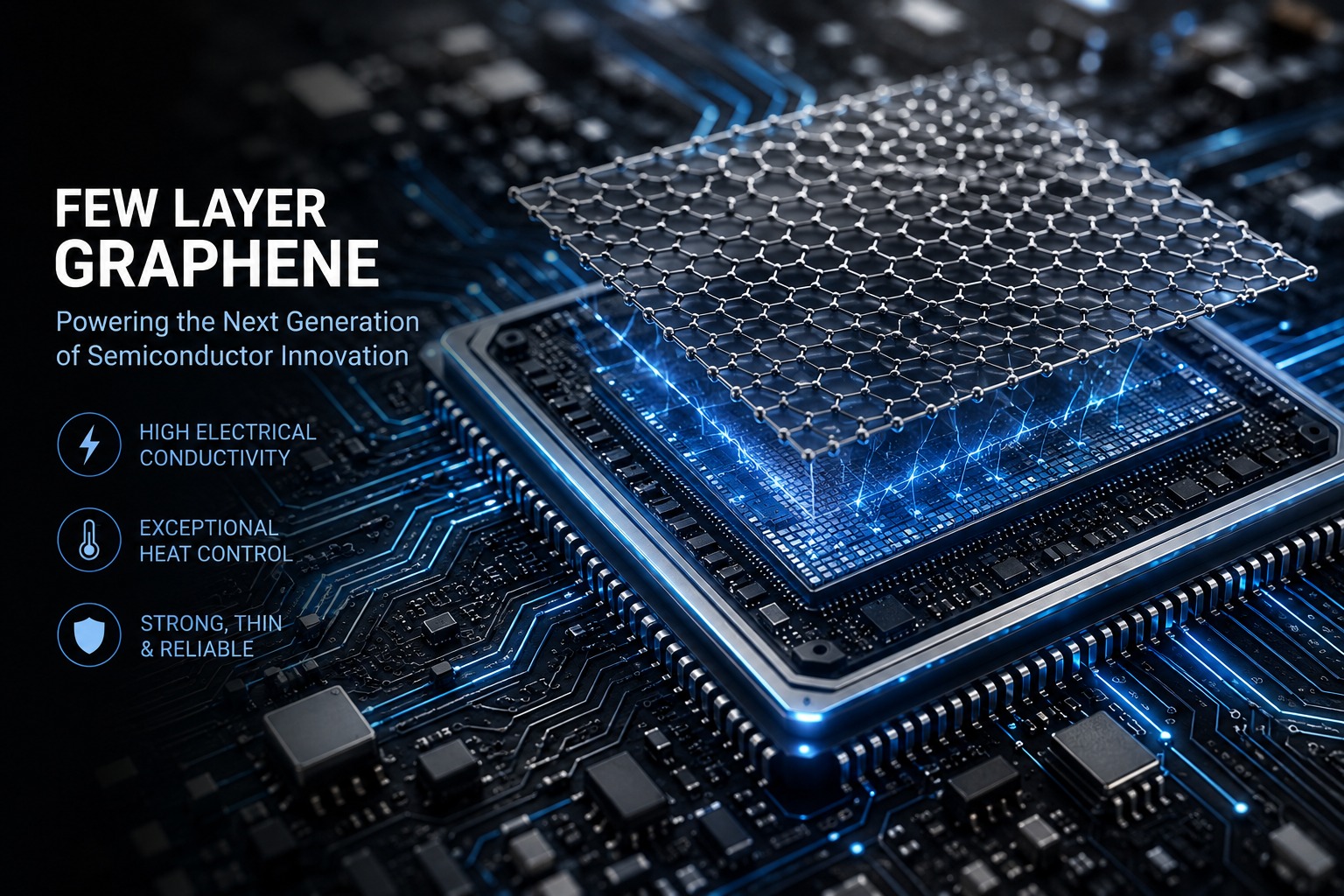
The global electronics landscape is currently witnessing a seismic shift as traditional silicon-based architectures approach their physical limits. Consequently, graphene semiconductor companies are aggressively exploring carbon allotropes to spearhead the next generation of high-performance computing.
By integrating Few Layer Graphene (FLG) into existing fabrication workflows, these pioneers are bridging the gap between theoretical physics and industrial-scale application.
As the demand for miniaturization and efficiency intensifies, the role of specialized material providers becomes paramount in ensuring that graphene semiconductor companies can maintain their competitive edge in a saturated global market.
Why Semiconductor Companies Are Looking at Graphene
The relentless pursuit of Moore’s Law has led the industry to a precarious crossroads. Silicon is struggling under the weight of modern processing demands, particularly regarding electron mobility and thermal leakage. We see a burgeoning interest in carbon-based nanomaterials because they offer a departure from the limitations of the past.
For enterprises engaged in high-level industrial partnerships often referred to as inter-corporate commerce or organizational trade, the shift to graphene is not merely a tren, it is a strategic necessity to ensure long-term viability in the semiconductor ecosystem.
Graphene Can Help Conduct Electricity
One of the primary reasons graphene semiconductor companies are prioritizing this material is its unparalleled charge carrier mobility.
At the atomic level, electrons move through graphene as if they have no mass, traveling significantly faster than they do in silicon. This ballistic transport mechanism allows for the creation of transistors that can operate at Terahertz frequencies.
When you integrate such high-speed conduits into your circuitry, the latency issues that plague traditional chips virtually vanish.
Graphene Can Support Heat Control
Thermal management remains a persistent bottleneck in high-density chip design. Excessive heat not only degrades performance but also significantly shortens the lifespan of the hardware.
Graphene’s exceptional thermal conductivity allows it to act as a highly efficient heat spreader. By incorporating graphene layers, we can facilitate rapid heat dissipation, ensuring that your most critical components remain within optimal operating temperatures even under grueling computational loads.
Graphene Is Thin but Strong
Despite being only one atom thick, graphene possesses a tensile strength that defies conventional logic. It is significantly stronger than steel yet incredibly flexible.
This mechanical resilience is vital for the development of flexible electronics and robust micro-electromechanical systems (MEMS). For your engineering teams, this means the ability to design components that are structurally sound at a microscopic scale, reducing material fatigue and failure rates in the field.
Why Few Layer Graphene Is Useful for Semiconductor Development
While single-layer graphene is a marvel of science, Few Layer Graphene (FLG) often provides the pragmatic "sweet spot" for industrial-scale manufacturing and material synthesis.
FLG offers a more tunable electronic structure, which is essential for creating the "bandgap" necessary for digital logic, something intrinsic graphene famously lacks.
It Can Be Used for Material Testing
In the realm of advanced material science, consistency is everything. FLG serves as an ideal substrate for rigorous material testing and characterization.
Because it maintains the core properties of graphene while being easier to handle in a lab environment, it allows for more reliable prototyping. This ensures that your R&D departments can validate theoretical models before moving into expensive, large-scale production phases.
It Can Support Conductive Parts
The versatility of Few Layer Graphene extends to its use in conductive inks, coatings, and composite fillers. In the context of semiconductor packaging, FLG can be utilized to create highly conductive interconnects and vias.
By choosing our high-purity FLG, you are investing in a material that minimizes resistance at critical junctions, thereby optimizing the power efficiency of the entire system-on-chip (SoC) architecture.
It Can Help Improve Product Performance
Ultimately, the integration of FLG leads to a measurable leap in end-product performance. Whether it is increasing the switching speed of a transistor or enhancing the sensitivity of a biosensor, the inclusion of our specialized graphene products provides a distinct advantage.
In a market where graphene semiconductor companies must constantly outpace their rivals, the superior electronic characteristics of FLG provide the necessary leverage to dominate the industry.
The transition toward carbon-centric electronics is inevitable, and the choice of material supplier will determine the leaders of tomorrow. As a premier producer of high-quality Few Layers Graphene, Ravphene Ravelware stands ready to support your most ambitious developmental goals.
Our commitment to precision and industrial-grade consistency ensures that your journey into the future of semiconductors is backed by the finest carbon materials available. Partner with us to redefine the boundaries of what is possible in the world of high-performance technology.
Recent Post

Extending Industrial Asset Lifespan Through Advanced Material Innovation
Aug 3, 2026

Building More Durable Infrastructure with Advanced Materials
Jul 28, 2026

Graphene in Smart Manufacturing: Enabling the Next Industrial Revolution
Jul 27, 2026

How Graphene Improves Corrosion Protection in Industrial Applications | RAVphene
Jul 21, 2026