
May 22, 2026
The semiconductor landscape is currently undergoing a seismic shift, driven by the inherent physical limitations of traditional silicon.
As we approach the boundaries of Moore’s Law, graphene computer chip manufacturers are aggressively scouting for revolutionary nanomaterials that can sustain the next generation of high-performance computing.
The transition from theoretical laboratory experiments to industrial-scale integration requires a material that offers not just superlative speed, but also structural integrity.
In this high-stakes environment of enterprise-level innovation, the strategic deployment of few-layer graphene (FLG) has emerged as a cornerstone for R&D departments aiming to outpace global competition.
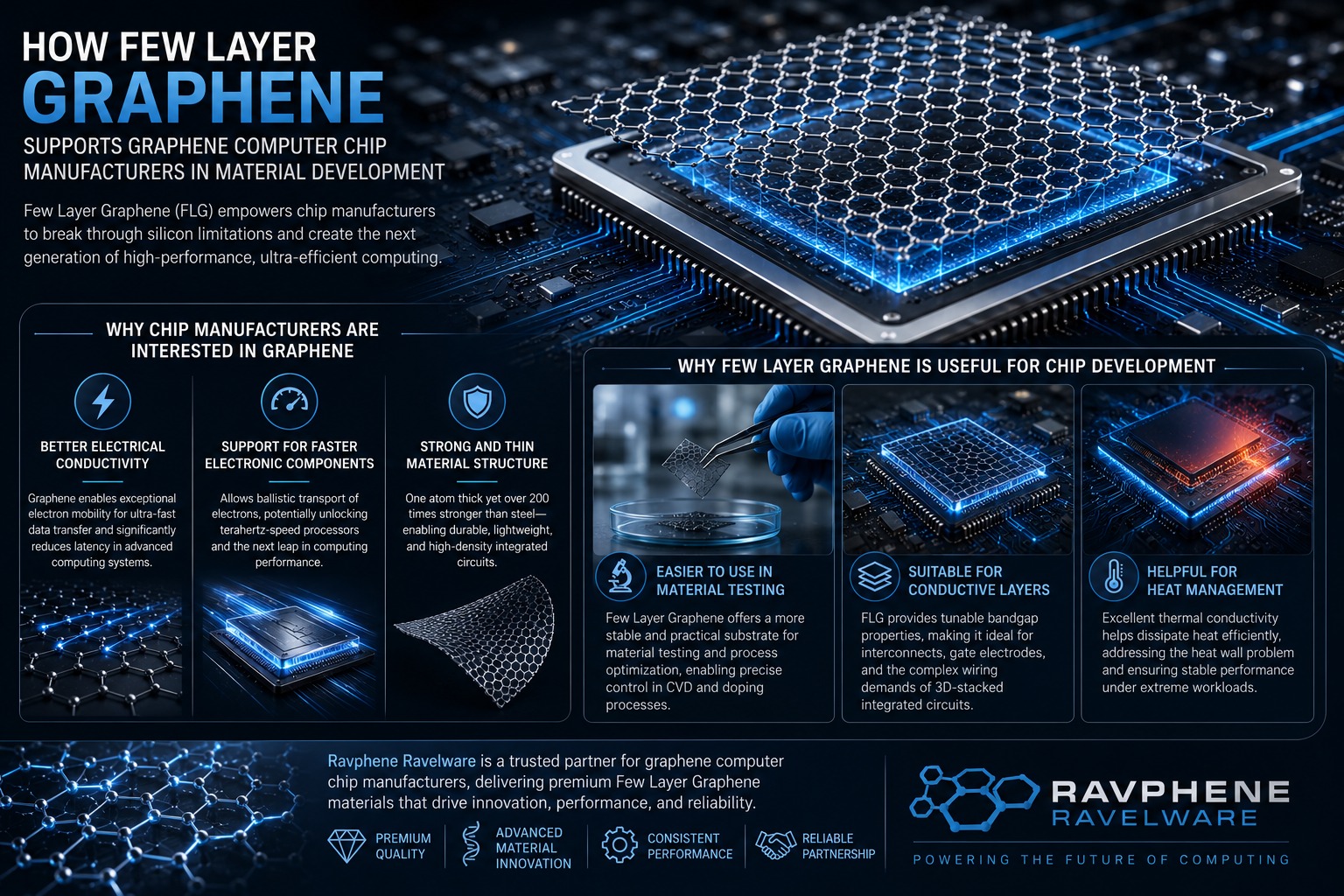
Why Chip Manufacturers Are Interested in Graphene
The global electronics industry is no longer satisfied with incremental upgrades; it demands a paradigm shift.
For graphene computer chip manufacturers, the allure of this carbon allotrope lies in its extraordinary hexagonal lattice, which provides a blueprint for a new era of ultra-efficient processing units.
Better Electrical Conductivity
Graphene’s electron mobility is nothing short of legendary. In the context of industrial-scale semiconductor fabrication, this translates to electrons moving at speeds that silicon simply cannot match.
By integrating graphene, we can facilitate near-instantaneous data transfer, significantly reducing latency within complex enterprise server architectures and high-frequency trading systems.
Support for Faster Electronic Components
Speed is the primary currency in the world of high-stakes technology. Because graphene allows for ballistic transport of electrons, the clock speeds of future processors could potentially reach the terahertz range.
This capability is why many graphene computer chip manufacturers are pivoting their long-term roadmaps toward carbon-based logic gates, ensuring that the future of corporate data infrastructure is built on a foundation of unprecedented velocity.
Strong and Thin Material Structure
Despite being only one atom thick, graphene is over 200 times stronger than steel. This unique combination of being lightweight yet exceptionally robust allows us to envision flexible, durable, and densely packed integrated circuits.
For entities engaged in industrial manufacturing, this structural stability ensures that chips can withstand the rigorous thermal and mechanical stresses of modern industrial applications.
Why Few Layer Graphene Is Useful for Chip Development
While single-layer graphene often dominates academic discourse, the practicalities of industrial material development often favor "Few Layer Graphene" (FLG).
This specific iteration provides a more versatile platform for graphene computer chip manufacturers to bridge the gap between experimental physics and commercial viability.
Easier to Use in Material Testing
Single-layer graphene can be notoriously temperamental to handle at scale. Few-layer graphene, however, offers a more tangible substrate for rigorous material testing.
It allows us to calibrate doping levels and surface functionalization with greater precision, providing your engineering teams with a reliable medium to refine the chemical vapor deposition (CVD) processes essential for high-yield production.
Suitable for Conductive Layers
In the multi-layered architecture of a modern microprocessor, FLG serves as an ideal intermediary.
Its tunable bandgap properties, a feature often lacking in pure monolayer graphene, make it exceptionally suitable for conductive interconnects and gate electrodes.
By utilizing FLG, we provide a robust solution for the complex wiring demands of 3D-stacked integrated circuits.
Helpful for Heat Management
Thermal throttling is the nemesis of high-density computing. The thermal conductivity of few-layer graphene remains remarkably high, allowing for efficient heat dissipation across the chip's surface.
For graphene computer chip manufacturers, integrating FLG is not just about electrical performance; it is a strategic move to solve the "heat wall" problem, ensuring that your hardware remains stable under the most demanding computational workloads.
The journey toward the ultimate semiconductor requires a partner who understands the intricacies of nanomaterial synthesis.
At the intersection of innovation and industrial reliability, Ravphene Ravelware stands as a premier provider of high-quality Few Layer Graphene products. We specialize in catering to the stringent requirements of professional material developers and technology pioneers.
By choosing our FLG solutions, your organization gains access to the premium building blocks necessary to lead the charge in the carbon revolution.
Let us collaborate to transform the future of computing, moving beyond silicon into a world of limitless potential with Ravphene Ravelware.
Recent Post

Extending Industrial Asset Lifespan Through Advanced Material Innovation
Aug 3, 2026

Building More Durable Infrastructure with Advanced Materials
Jul 28, 2026

Graphene in Smart Manufacturing: Enabling the Next Industrial Revolution
Jul 27, 2026
How Graphene Improves Corrosion Protection in Industrial Applications | RAVphene
Jul 21, 2026